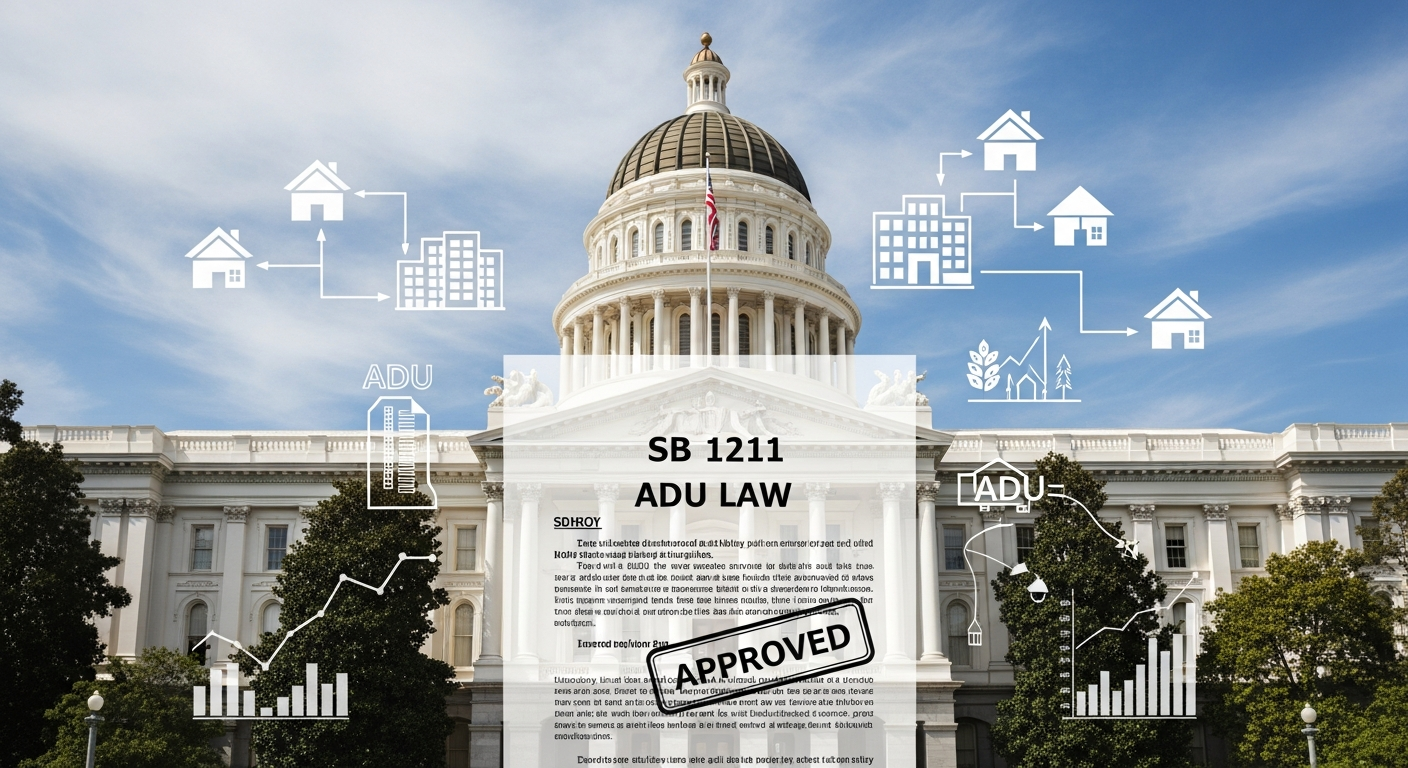
California Senate Bill 1211 (SB 1211) represents one of the most significant expansions of Accessory Dwelling Unit (ADU) rights since the landmark SB 9 legislation. Signed into law in 2024 and taking effect January 1, 2025, this comprehensive legislation removes critical barriers that have prevented thousands of California homeowners from building ADUs on their properties.
If you're a California homeowner considering building an ADU, understanding SB 1211 is essential. This guide provides everything you need to know about the new law, how it affects your property, and how to take advantage of these expanded rights.
Ready to Build Your ADU?
Our team specializes in navigating California's ADU regulations. Get a free consultation to learn how SB 1211 applies to your property.
Call us today: (323) 591-3717
What is California SB 1211?
Senate Bill 1211, authored by Senator Anna Caballero, is landmark housing legislation that amends key sections of the California Government Code (specifically Sections 66313, 66314, and 66323) to remove barriers to ADU construction.[1] The bill received bipartisan support and was signed by Governor Gavin Newsom as part of California's ongoing efforts to address the housing crisis.
The legislation builds upon California's existing ADU framework established by previous bills including AB 68, AB 881, SB 13, and AB 3182. However, SB 1211 goes further by addressing several critical obstacles that local jurisdictions have used to limit or prohibit ADU development.[2]
Key Provisions of SB 1211
SB 1211 introduces several transformative changes to California's ADU regulations:
- Prohibits Owner-Occupancy Requirements for Permit Approval: Local agencies cannot require owner-occupancy as a condition for approving an ADU permit application. This removes one of the most significant barriers that prevented homeowners from building ADUs.
- Limits Deed Restrictions: The law restricts the ability of local governments to impose deed restrictions that could limit ADU rentals or usage.
- Streamlines Permitting Timelines: Reinforces the 60-day permit processing requirement for ADU applications that meet all objective standards.
- Expands Eligible Properties: Clarifies that ADUs can be built on properties regardless of certain previous restrictions, expanding the pool of eligible lots.
- Protects Against Unreasonable Fees: Further limits impact fees and connection charges that local jurisdictions can impose on ADU construction.
Why SB 1211 Matters for California Homeowners
California faces a severe housing shortage, with estimates suggesting the state needs to build 2.5 million homes by 2030 to meet demand. ADUs represent one of the most cost-effective and community-friendly solutions to this crisis, yet bureaucratic barriers have historically limited their construction.[3]
The Owner-Occupancy Problem
Before SB 1211, many California cities required property owners to live on-site as a condition of building an ADU. This restriction created several problems:
- Investment Barrier: Homeowners who wanted to rent both their primary residence and ADU were prohibited from doing so, limiting the financial viability of ADU construction.
- Mobility Restrictions: Homeowners who needed to relocate for work or family reasons faced losing their ADU rights or being forced to sell their property.
- Inheritance Complications: Properties with ADUs faced legal complications when passed to heirs who didn't intend to live on-site.
- Financing Challenges: Lenders were hesitant to finance ADU construction when occupancy requirements created future uncertainty.
According to the Los Angeles County Department of Regional Planning, the elimination of owner-occupancy requirements is expected to increase ADU applications by 25-40% in jurisdictions where these restrictions previously existed.[4]
How SB 1211 Changes ADU Development
Let's examine the specific ways SB 1211 affects ADU development in California:
1. No More Owner-Occupancy Requirements for Permits
Prior to SB 1211, many cities required property owners to sign affidavits promising to live on the property as a condition of receiving an ADU permit. Some jurisdictions even required owner-occupancy for the life of the ADU or until the property was sold.
Under SB 1211: Local agencies are explicitly prohibited from requiring owner-occupancy as a condition for ADU permit approval. This means you can build an ADU and rent out both your primary residence and the ADU from day one.[1]
2. Deed Restriction Limitations
Some jurisdictions attempted to enforce owner-occupancy through deed restrictions recorded against the property. These restrictions could affect property sales and create title complications.
Under SB 1211: The law limits the ability of local governments to require deed restrictions related to ADU occupancy. Existing deed restrictions may be challengeable under the new framework.[2]
3. Reinforced Permitting Timelines
California law already required 60-day permit processing for ADUs, but many jurisdictions found ways to delay approvals through multiple review cycles, incomplete application designations, or additional requirements.
Under SB 1211: The legislation reinforces the 60-day timeline and provides clearer enforcement mechanisms. Applications that meet all objective standards must be approved within this timeframe.[5]
Understanding "Objective Standards"
Under California law, objective standards are requirements that involve no personal judgment and can be verified by reference to an external and uniform benchmark. Examples include:
- Maximum square footage limits
- Height restrictions
- Setback requirements
- Lot coverage maximums
Subjective requirements like "neighborhood compatibility" or "aesthetic harmony" cannot be used to deny ADU permits.
4. Fee Protections
Excessive fees have historically been used to discourage ADU construction. Some jurisdictions charged tens of thousands of dollars in impact fees, connection fees, and other charges.
Under SB 1211: The law further restricts fee collection, building on previous legislation that already prohibited impact fees for ADUs under 750 square feet and limited fees for larger units.[4]
SB 1211 Implementation Timeline
| Date | Milestone |
|---|---|
| February 15, 2024 | Bill introduced in California Senate |
| May 2024 | Passed Senate Housing Committee with bipartisan support |
| August 2024 | Passed State Assembly |
| September 2024 | Signed by Governor Newsom |
| January 1, 2025 | Law takes effect statewide |
As noted by California YIMBY, the bill's passage represents a significant victory for housing advocates who have long argued that owner-occupancy requirements serve as unnecessary barriers to housing production.[6]
How SB 1211 Interacts with Existing ADU Laws
SB 1211 doesn't exist in isolation—it builds upon and strengthens California's existing ADU framework. Here's how it interacts with other key legislation:
SB 9 (California HOME Act)
SB 9 allows lot splits and duplexes on single-family zoned properties. SB 1211 ensures that ADUs built on SB 9 lot splits receive the same protections against owner-occupancy requirements as ADUs on traditional single-family lots.
AB 68 and AB 881 (2019 ADU Laws)
These laws established the modern ADU framework, including size limits, setback requirements, and streamlined permitting. SB 1211 strengthens these provisions by removing loopholes local jurisdictions used to circumvent state law.
AB 3182 (2020 HOA Restrictions)
This law limited HOA restrictions on ADUs. SB 1211 complements these provisions by ensuring that even in HOA communities, owner-occupancy cannot be required for ADU approval.
What This Means for Your Property
If you're a California property owner, SB 1211 likely expands your ADU development options. Here's how to evaluate your situation:
Properties Previously Denied Due to Owner-Occupancy
If you previously explored building an ADU but were discouraged by owner-occupancy requirements, SB 1211 may remove that barrier. Contact your local planning department to inquire about reapplying under the new law.
Investment Properties
For the first time, California investors can build ADUs on non-owner-occupied properties without facing occupancy restrictions. This opens significant opportunities for real estate investors looking to maximize rental income.
Inherited Properties
If you've inherited property with an existing ADU subject to owner-occupancy restrictions, SB 1211 may provide grounds to challenge or remove those restrictions. Consult with a real estate attorney familiar with the new law.
Find Out What SB 1211 Means for Your Property
Every property is unique. Our ADU experts can evaluate your specific situation and explain how the new law applies to you.
Call us: (323) 591-3717
Common Questions About SB 1211
Does SB 1211 apply to all California cities?
Yes. SB 1211 is state law that supersedes local ordinances. All California cities and counties must comply with its provisions as of January 1, 2025. Local jurisdictions cannot impose owner-occupancy requirements that conflict with state law.
What about existing owner-occupancy deed restrictions?
The City of Marina's implementation guidance notes that existing deed restrictions may be affected by SB 1211, though the specific impact depends on when the restriction was recorded and how it was structured.[5] Property owners with existing restrictions should consult with a real estate attorney.
Can my HOA still require owner-occupancy?
No. HOAs cannot impose requirements that exceed state law. Since state law now prohibits owner-occupancy requirements for ADU permits, HOAs cannot enforce such requirements either.
Does this change affect JADU (Junior ADU) regulations?
Junior ADUs (JADUs) have historically required owner-occupancy because they are contained within the primary residence. SB 1211's provisions apply primarily to detached ADUs and attached ADUs that are separate from the main living space. JADU regulations may have different requirements—consult your local planning department for specifics.
Can I now build multiple ADUs without living on-site?
California law allows one ADU and one JADU per single-family lot (or more on multi-family properties). SB 1211 removes owner-occupancy as a condition for ADU approval, but it doesn't change the fundamental limits on how many ADUs you can build.
ADU Financing After SB 1211
One often-overlooked benefit of SB 1211 is its impact on ADU financing. Lenders have historically been cautious about ADU construction loans due to owner-occupancy uncertainties. With clearer legal protections:
- More Lending Options: Banks and credit unions may offer more competitive ADU financing products.
- Better Appraisal Values: ADUs without occupancy restrictions typically appraise higher because they offer more flexibility to future buyers.
- Investment Property Loans: Investors can now finance ADU construction using investment property loan products rather than requiring owner-occupied financing.
Steps to Build an ADU Under SB 1211
Ready to take advantage of California's expanded ADU rights? Here's a step-by-step guide:
Step 1: Verify Your Property's Eligibility
While SB 1211 expands ADU rights, basic eligibility requirements still apply. Your property must:
- Be zoned residential (single-family or multi-family)
- Have an existing or proposed primary dwelling
- Meet minimum lot size requirements (typically none for JADUs, varies for ADUs)
- Not be located in certain restricted areas (fire hazard zones may have additional requirements)
Step 2: Develop Your ADU Design
Work with an architect or ADU designer to create plans that meet California building code and your local jurisdiction's objective standards. Consider:
- ADU size (up to 1,200 sq ft for detached units)
- Placement on your lot (4-foot side and rear setbacks for new construction)
- Height limits (16 feet for detached ADUs, or local limit, whichever is less restrictive)
- Parking requirements (often waived for ADUs near transit)
Step 3: Submit Your Permit Application
Prepare a complete application package including:
- Site plan showing ADU location
- Floor plans and elevations
- Title 24 energy calculations
- Any required structural engineering
Step 4: 60-Day Review Period
Once your application is deemed complete, the city has 60 days to approve or deny it. Under SB 1211, they cannot require owner-occupancy as a condition of approval.
Step 5: Construction
With your permit in hand, begin construction. Most ADUs take 4-8 months to build, depending on complexity and contractor availability.
How GatherADU Can Help
Navigating California's ADU regulations can be complex, but you don't have to do it alone. GatherADU specializes in helping California homeowners build ADUs from concept to completion.
Our Services Include:
- Free Feasibility Analysis: We evaluate your property and explain exactly what's possible under current law, including SB 1211.
- Design Services: Our architects create permit-ready ADU designs tailored to your property and goals.
- Permit Processing: We handle all permit submissions and communicate with your local planning department.
- Construction Management: Our team oversees construction to ensure quality and timeline adherence.
- Financing Guidance: We connect you with lenders who understand ADU projects.
Start Your ADU Project Today
With SB 1211 now in effect, there's never been a better time to build an ADU in California. Let our experts guide you through the process.
Call us: (323) 591-3717
Or schedule a free consultation online:
The Future of ADU Development in California
SB 1211 is part of a broader trend toward expanding housing options in California. The legislature continues to consider additional reforms, including:
- Further streamlining permit processes
- Expanding ADU rights to more property types
- Creating state-level financing programs for ADU construction
- Establishing statewide pre-approved ADU plans
By building an ADU now, you position yourself to benefit from both current law and future expansions of ADU rights.
Conclusion
California SB 1211 represents a significant victory for property rights and housing production. By eliminating owner-occupancy requirements and strengthening existing ADU protections, the law opens doors for thousands of California homeowners to build ADUs on their properties.
Whether you're looking to generate rental income, house family members, or simply add value to your property, ADUs offer a flexible and cost-effective solution. With SB 1211's protections in place, building an ADU in California is more accessible than ever.
Don't wait to explore your options. Contact GatherADU today to learn how SB 1211 applies to your property and start your ADU journey with confidence.
References & Citations
- California Legislative Information. "SB-1211 Accessory dwelling units: owner-occupancy requirements." Legislature.ca.gov. https://leginfo.legislature.ca.gov/faces/billNavClient.xhtml?bill_id=202320240SB1211
- LegiScan. "California SB1211 | 2023-2024 | Regular Session." LegiScan.com. https://legiscan.com/CA/text/SB1211/id/3021784
- CalMatters Digital Democracy. "SB 1211: Accessory dwelling units: owner-occupancy requirements." CalMatters.org. https://calmatters.digitaldemocracy.org/bills/ca_202320240sb1211
- Los Angeles County Department of Regional Planning. "ADU Implementation Memo - SB 1211 Updates." Planning.LACounty.gov, November 2024. https://planning.lacounty.gov/wp-content/uploads/2025/03/ADU_Memo_20241125.pdf
- City of Marina. "SB 1211 Implementation Summary." CityofMarina.org. https://cityofmarina.org/DocumentCenter/View/15635
- California YIMBY. "SB 1211 - Accessory Dwelling Units: Owner-Occupancy." CAYIMBY.org. https://cayimby.org/legislation/sb-1211/
This article is for informational purposes only and does not constitute legal advice. ADU regulations vary by jurisdiction and individual circumstances. Consult with qualified professionals before making decisions about ADU construction.